
SPR in Poker: How to Calculate the Ratio of Effective Stack to Pot

To calculate SPR at the start of the flop in a heads-up pot, with two players contesting it, divide the smaller remaining stack by the size of the pot built by the end of preflop play. SPR stands for stack-to-pot ratio: the relationship between the effective chips still available and the chips already in the pot. [2][3]
The number helps answer a concrete question: how much more can be put at stake relative to what is already being contested? In No-Limit Texas Hold’em, looking at the stack alone does not describe this entire relationship. The same number of chips can represent deeper or shallower play depending on the size of the pot. [1]
SPR in Poker: Setting Up the Calculation at the Start of the Flop
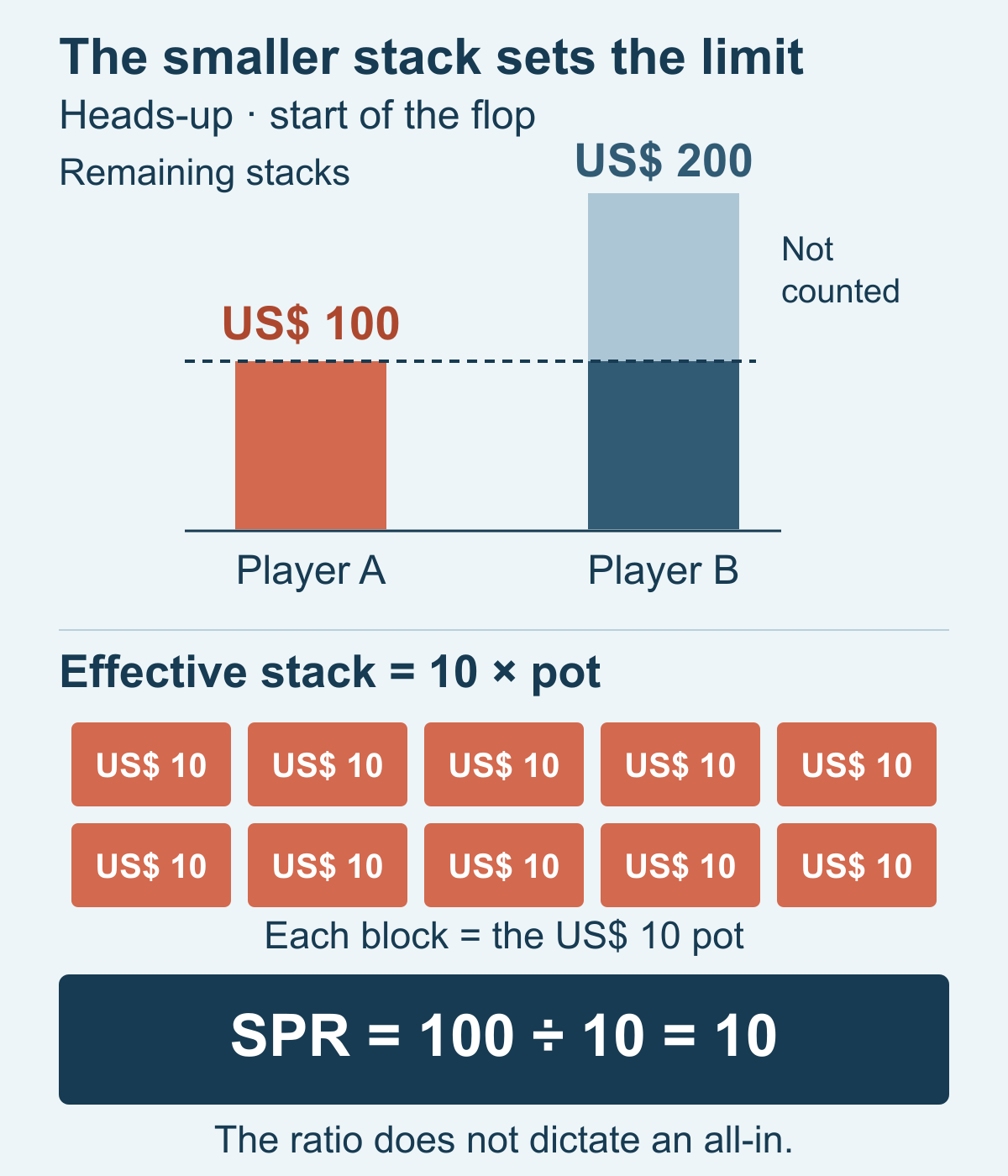
An example from MaisEV presents two players with remaining stacks of US$100.00 and US$200.00 at the start of the flop, facing a US$10.00 pot. The smaller stack goes in the numerator; the pot goes in the denominator: [3]
SPR = US$100.00 ÷ US$10.00 = 10.
The result means that the effective stack is ten times the pot. The larger stack is not used in the division because the player with fewer chips limits the amount the two can contest against each other.
To calculate SPR for another hand:
Starting stack: do not use it for flop SPR, because it includes chips already put into the pot.
Remaining effective stack: use the smaller of the two stacks at the start of the flop, before any betting on that street.
Pot size: use the total built by the end of preflop play, measured at the same moment as the stacks. [2][3]
Use the same unit for both amounts. You can express the stack and pot in money, chips, or big blinds, provided both use the same unit. Dividing a stack in big blinds by a pot recorded in money mixes reference points. When the units match, they cancel out in the division: the resulting SPR is a ratio, not a monetary amount.
If the pot is estimated, the calculated SPR is approximate too. [2]
SPR Helps Assess Risk but Does Not Dictate an All-In
A lower SPR indicates fewer effective chips remaining relative to the pot. This helps assess the commitment involved in playing for the entire stack, but it does not create an obligation to bet or call. The division alone does not account for the board cards, the opponent’s possible hands, or the action you face. Applying it as a rigid rule removes the very context needed to make a decision. [2]
The relationship between risk and reward explains why the concept is useful. The more chips you risk compared with the existing pot, the stronger your hand needs to be to justify that risk. The analysis also needs to consider the other side: opponents willing to play for larger stacks relative to the pot may do so with stronger sets of hands. The assessment therefore involves both depth and the hands you expect to play against. [1]
Committing the stack and choosing the sequence of actions are different questions. Even when your hand and the situation allow you to play for all your chips, the line does not have to begin with a bet or an all-in. A check can be part of the plan in a low-SPR pot. The guidance depends on how the opponent tends to act and which responses you hope to get, not just on the result of the division. [2]
Do not turn an SPR classification into universal commitment bands. Consider the opponent’s tendencies and all-in range—the hands with which they are willing to put all their chips at stake—when assessing the matchup. [3]
The focus here is the start of the flop. As the hand progresses, bets change both the remaining stacks and the pot. A new division then describes a different moment. Reassessing this relationship can be useful, but it does not mean automatically carrying the same commitment criteria used on the flop over to the turn or river. You need to distinguish the arithmetic update from the strategic interpretation applied to it. [2]
With more than two players, effective stack relationships differ. In a multiway pot, the smallest stack overall does not by itself describe the depth of every matchup. Two participants with more chips may have a different effective stack relationship with each other than either has against a shorter stack. The calculation should consider the relevant pairs of opponents instead of reducing the entire contest to a single minimum stack. This is an extension of the concept; it is not the same heads-up scenario used in the initial calculation. [3]
How to Compare Scenarios Without Creating Automatic Rules
The formula lets you identify what changes when the stack and pot vary. In the comparisons below, the amounts always refer to the start of the flop in a pot with two players. These are arithmetic relationships between the variables, with no associated betting recommendations. [2]
| Comparison between situations | Effect on SPR | Reason |
|---|---|---|
| Same remaining effective stack, with a larger pot | SPR decreases | The same numerator is divided by a larger denominator. |
| Same pot, with a larger remaining effective stack | SPR increases | More effective chips are available relative to the same pot. |
| Effective stack and pot increase in the same proportion | SPR stays the same | The relationship between the two amounts is preserved. |
| Only the larger stack increases, with no change to the smaller stack or the pot | SPR stays the same | The effective stack remains the smaller of the two. |
The same SPR can correspond to stacks and pots with different absolute values. The ratio lets you compare relative depth; to know how much money is at stake, also check the original amounts.
Even with the same SPR, the hands each player could hold, position relative to the opponent, and the opponent’s playing style can make different actions appropriate. [1][2][3]
After the Calculation, Build a Plan for the Hand
If the question is whether to bet or check, clarify what response you hope to get from the opponent before moving on to choosing a bet size. [2]
If the question is whether to call a bet, the next concept to explore is calculating pot odds. This analysis relates the cost of calling to the pot and helps assess the specific price of the decision. SPR describes the remaining depth; pot odds examine the call you face. In strategic analysis, that price still needs to be related to your hand’s chances against the opponent’s possible hands. [1]
Recommended reading
- Cash Game Strategy: Position, Betting, and Stack Size
- Poker Bet Sizing: Amount, Purpose, and Context
- How to Calculate Pot Odds in Texas Hold’em: A Practical Guide to Calling or Folding
Sources
- [1] Stack-to-pot ratio — GTO Wizard — November 17, 2022.
- [2] SPR Strategy And Concept In Poker In 2026 — SplitSuit Poker — January 17, 2025.
- [3] Understanding and Using SPR — MaisEV — January 19, 2011.
 1 day ago