How to Calculate Pot Odds in Texas Hold’em: A Practical Guide to Calling or Folding

To calculate pot odds as a percentage, divide the cost of the call—the amount needed to call the bet—by the total pot after calling and multiply by one hundred. Compare this price with your hand’s equity: your chances in the contest for the pot against the opponent’s possible hands. The comparison is more direct when there will be no further bets to consider. [1][2]
Why this matters: comparing price and equity helps you decide between calling and folding while also considering possible future costs. [2]
Summary

- Pot odds describe the price of calling; equity assesses your chances in the contest.
- The percentage calculation includes your call in the final pot.
- With no future costs, an equity estimate above the threshold favors calling; below it, the direct price does not support the call.
- On the flop and turn, future bets and implied odds can change the analysis. Expected winnings are not guaranteed.
How to Calculate Pot Odds: Start with the Cost of the Call
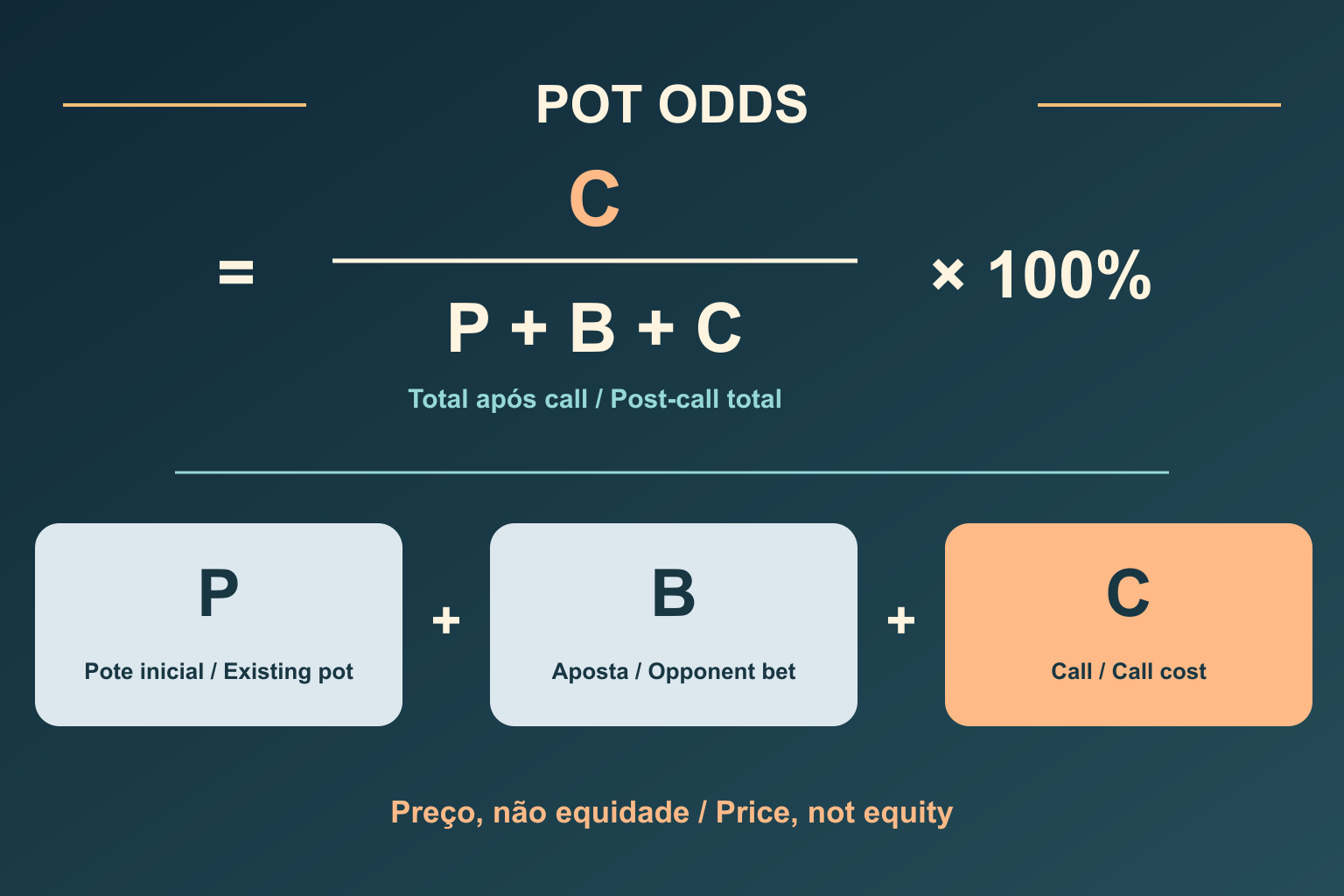
Separate the pot before the bet, the bet you are facing, and the amount needed to call. There are two ways to present the price: the ratio compares the pot available before the call with the cost of calling; the percentage divides that cost by the pot after the call. [2][3]
Hypothetical example: while reviewing a river decision in a two-player Texas Hold’em hand, you want to check which pot to use for the ratio and which to use for the percentage. You have not yet contributed during this betting round, and the call will fully match the opponent’s bet. There is no rake or other fees, no side pots, and no subsequent bets to consider. The pot before the bet is R$90.00. The opponent’s bet is R$30.00. The cost of the call is R$30.00. To calculate the ratio, the pot available before the call is R$120.00: add the pot that existed before the bet to the bet you are facing, without including your call. The pot odds are 4:1, calculated by dividing that amount by the cost of the call. To calculate the percentage, the final pot after the call is R$150.00: now include your call as well. The call-price threshold is 20.00%, calculated by dividing the cost of the call by the final pot and multiplying by one hundred.
The ratio indicates how much is already available for each real risked. The percentage shows how much of the final pot your call represents. Both calculations describe the same price using different totals. The figures illustrate the formula; they are not a case presented by the sources.
The result does not indicate your hand’s equity: no cards or opposing hands were defined in the example. It establishes the point of comparison. Under these assumptions, an equity estimate above the threshold favors calling; one below it favors folding. At the break-even point, the simplified calculation indicates no profit. [2]
The practical lesson: when converting the ratio into a percentage, add the call to the pot used as the denominator.
Why This Calculation Confuses Beginners
The money available and the cost of continuing come from the bets. Assessing your hand requires different information: what the opponent may have. PokerListings emphasizes that calculating pot odds is only part of the work; you then need to compare the price with your equity. [1]
You do not need to be the favorite. Because there is already money in the pot, a call can be profitable even when it loses more often than it wins. The relationship between the amount risked and the amount available makes this possible. The useful question is whether your chances justify that price under the conditions of the hand. [2]
This does not eliminate the need to read your opponent. An exact price calculation can be compared with a poor equity estimate. To make this assessment, you need to consider the opponent’s possible hands and, when there are still cards to come, your chances of making a better hand. [1]
Completing a draw does not guarantee a win. A draw is an incomplete hand, such as a flush draw. The cards that can come and give you the best hand are called outs. That last condition matters: improving your combination does not necessarily mean beating your opponent. [1][3]
With flush draws, the possibility that the opponent has a better flush reduces the value of your prospects of improving and can lead to additional losses later. Therefore, the chance of completing a draw should not automatically be treated as the chance of winning the pot. [2]
Profitability is a long-term assessment. Expected value, or EV, expresses the average gain or loss from an action if it were repeated under the same circumstances. A favorable calculation does not promise that you will win that specific hand. [3]
What this means: when reviewing a decision, identify whether the uncertainty was in calculating the price or assessing the possible hands. These are separate steps.
How to Calculate Pot Odds: What to Check Before Calling
The central distinction is knowing whether the current call ends your costs or whether there may be further bets to pay. The direct comparison between price and equity is clearer when facing an all-in with no subsequent payments or when making the final decision before the cards are shown. [2]
Future bets require a new assessment. On the river, there is no further betting round. On the flop and turn, however, calling a bet may lead to another decision, with another price and fewer cards to come.
888poker illustrates this limitation with a flush draw facing a half-pot bet on the flop. If the player calls, the turn does not complete the draw, and the opponent bets again, a new cost arises, now with only one card to come. [2]
The first call does not guarantee access to the river at the same price. Using the prospect of completing the draw over the two remaining cards requires accounting for this possible additional charge. When facing the new bet, you need to reassess the price and your prospects of improving.
Implied odds depend on receiving money later. They add to the analysis the money you expect to win in subsequent betting rounds if you complete your hand. This expectation can justify a call that is not supported by the current pot alone when there are still chips to bet and a possibility of getting paid. [1][2][3]
The direct price uses the money already available; implied odds depend on how much the opponent may pay later. [2][3]
888poker recommends considering your position in the order of action, the possibility of facing a better flush, and the size of the bet you would need to be paid on the river. The larger the future payment needed to justify the call, the less reliable the implied odds become: the opponent may fold marginal hands. [2]
Multiway pots increase the importance of these conditions. In multiway pots, with several players contesting the pot, Poker na Chapa highlights the relevance of implied odds, as it does in hands against opponents who call many bets. The same source presents reverse implied odds: future losses that can occur even when you complete your draw because your hand ends up second best. [3]
With more players in the pot, your chances of winning it decrease. The equity estimate must therefore consider the possible hands of all opponents still contesting the pot, not just one. [1] This does not guarantee future payments. The previous example, involving two players and no subsequent bets, does not cover these differences.
The practical lesson: if the call depends on future payment, assess who may pay, how much you would need to receive, and the risk of completing a hand that is still inferior.
How to Practice Without Developing Bad Habits
Poker na Chapa recommends starting with draw situations on the flop and turn, as well as reviewing hands away from the table and calculating pot odds and expected value for the relevant decisions. This study allows you to work through the calculation and interpretation more carefully. [3]
Organize the review into three steps:
- Reconstruct the decision. Record the pot, the bet you faced, and the cost of the call, distinguishing the money available before calling from the total after it.
- Record the hand assessment. Identify the opponent’s possible hands that supported your equity estimate.
- Examine what could still happen. Check whether there could be further bets and whether the reasoning depended on future winnings, while also accounting for possible additional losses. [1][2][3]
Memorize the relationships after understanding the calculation. Memorizing the prices associated with bet sizes reduces the calculation effort required during the hand. This frees up attention to interpret your opponent, but it does not do that reading for you. [2]
The practical lesson: use the review to locate what needs improvement—calculation, equity estimation, or assessment of future bets—instead of judging the call solely by the outcome of that hand. [3]
The Next Step: Review the Price and the Conditions
Choose a hand you have already played and redo the decision away from the table. Record the price you found and the reasoning behind the call or fold. If the uncertainty involves the expectation of future payment, focus the review on that assumption. [3]
Frequently Asked Questions
Does the Amount of My Call Go in the Denominator?
Yes. In the percentage calculation, the denominator is the total pot after calling, including the bet you are facing and your call.
Are Pot Odds and Equity the Same Thing?
No. Pot odds describe the price of continuing; equity assesses your chances in the contest against the opponent’s possible hands.
Do I Need to Be the Favorite to Call a Bet?
Not necessarily. With no further costs, a call can be profitable when your equity exceeds the price threshold, even if you lose more often than you win.
Can I Use the Chance of Completing the Draw by the River to Justify Any Call on the Flop?
No. A subsequent bet on the turn may create another cost. The flop call does not guarantee that you will see both remaining cards for the same price.
Does a Multiway Pot Make Implied Odds Guaranteed?
No. They remain expected winnings. There is also the risk of losing more money after completing an inferior hand, which is accounted for by reverse implied odds.
Sources
- [1] Calculate Pot Odds and Equity in Poker | Easy Poker Math — PokerListings — Arved Klöhn. Published November 10, 2021; updated July 24, 2026.
- [2] Pot Odds in Poker: How to Calculate & Use Them — 888poker — Published April 27, 2026.
- [3] Poker Math: Pot Odds, EV, and Essential Calculations — Poker na Chapa — Published April 16, 2025.

 2 days ago