
Kicker in Poker: Guide to Tiebreakers and Splitting the Pot
A kicker in poker is a side card that can break ties between hands with the same combination, provided it is part of the best five-card hand. Why this matters: having the same pair is not enough to split the pot—the side cards can still determine the winner. [3]
Summary
- Compare the combination before the kicker. With two pair, both pairs must be the same as your opponent’s for the fifth card to decide.
- Your hole cards may not play. At showdown with all the community cards dealt, you can use both, one, or neither of them.
- Not every combination uses a kicker. Straights, flushes, and full houses already occupy all five cards in the hand.
- The tie must be complete. The pot is split when the best hands in contention tie in both category and the values of all five cards.
The Kicker in Poker Depends on the Best Five Cards
At showdown with all the community cards dealt, players compare their hands after the river betting round, with the river being the fifth and final community card. Each player has seven available cards: two hole cards and five on the board, as the community cards are called. Of those seven cards, only the best five are used to evaluate the hand. You may use both hole cards, only one, or neither. [1]
A kicker completes a hand whose main combination occupies fewer than five cards, such as one pair, two pair, three of a kind, or four of a kind. One pair has three side cards; three of a kind has two; two pair and four of a kind each have one. The kicker may also come from the board. A card left out of the final hand provides no additional tiebreaker: there is no sixth card to break the tie. [3]
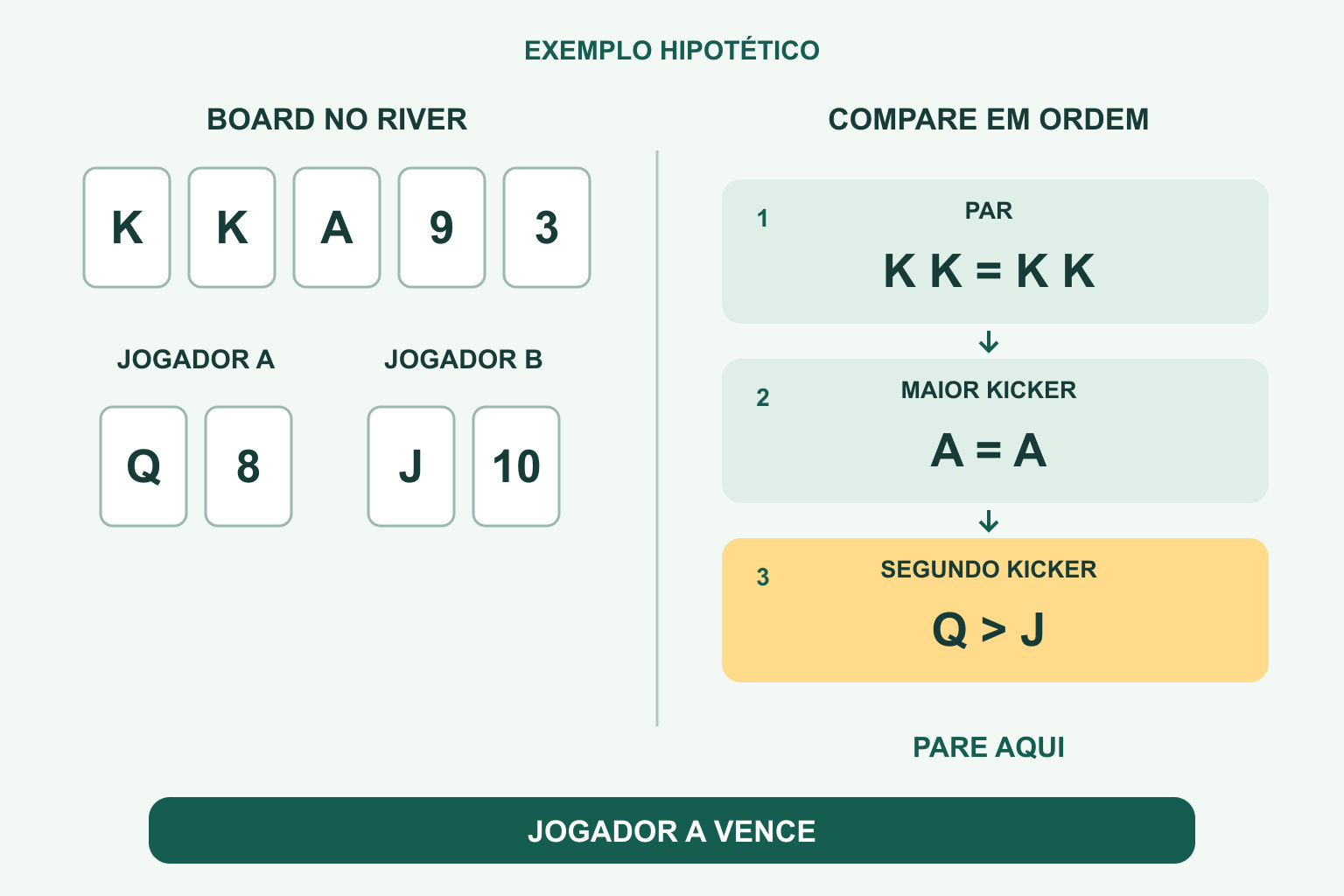
First, confirm the rank of the pair. Kickers only enter the comparison when the pairs have the same rank; a higher side card does not change the hand category. If the pair is tied, compare the side cards from highest to lowest and stop at the first difference. [4]
Hypothetical example: the highest kicker also ties. On the river, the board is K♣ K♦ A♥ 9♠ 3♣. Player A has Q♣ 8♦, and Player B has J♥ 10♣. Player A’s best hand is K♣ K♦ A♥ Q♣ 9♠; Player B’s is K♣ K♦ A♥ J♥ 10♣. Both have a pair of kings and an ace as their highest kicker. Player A wins: the queen beats the jack when comparing the second kicker. Player B’s ten does not make up for the earlier difference between the queen and the jack.
Notice that Player A uses only one hole card, the queen: the nine on the board outranks the eight. Player B uses both hole cards, the jack and the ten. Each player selects their own combination from the available cards, even though the board is shared.
The practical lesson: compare the side cards in order and stop at the first difference.
Why This Tiebreaker Confuses Beginners
Treating the second hole card as a mandatory kicker. The fact that you were dealt a card does not give it priority over the community cards. A card from the board may take its place in the final hand.
Calling every tiebreaker a kicker. Straights, flushes, and full houses use five cards, with no external kicker; a full house consists of three cards from the three of a kind and two from the pair. Cards outside these combinations do not enter the tiebreaker. Hands without a kicker do not automatically tie: compare the complete combination. [3][4]
Confusing top pair with a guaranteed advantage. Top pair is a pair made with the highest card on the flop. Even with that pair, you may face an opponent with the same pair and a higher side card. [3]
This evaluation considers the cards available on the flop. The subsequent community cards must still be considered before reaching a showdown result after the river.
The practical lesson: if your opponent has the same pair, compare the side cards.
Kicker in Poker: What to Correct First
Two pair: the fifth card decides only after both pairs are tied. When players have exactly the same two pair, four cards in the combination are already tied. The fifth card is the kicker: if its rank differs, the higher one decides; if it also ties, the hands remain equal. [3]
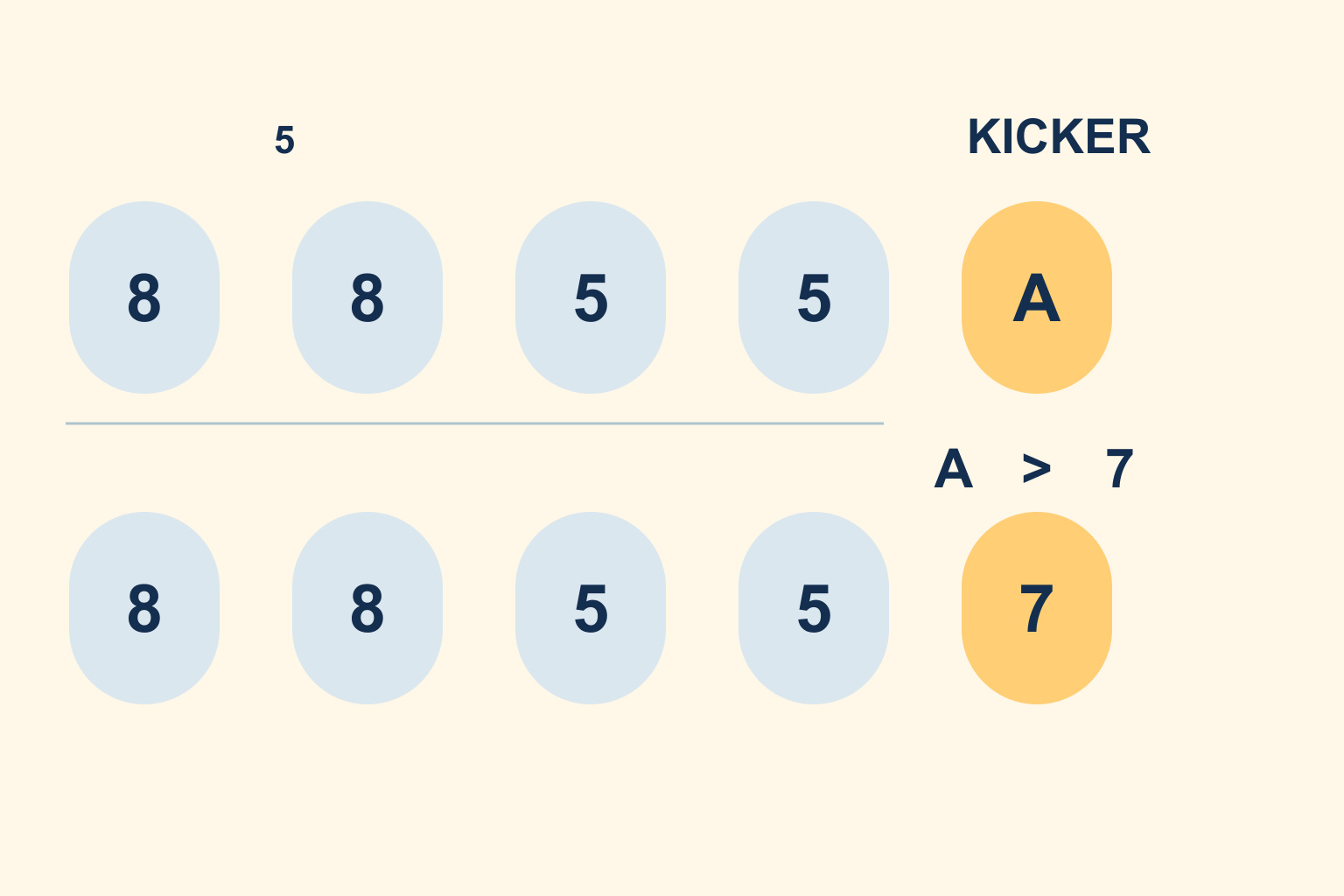
In the PokerNews example, A-8 faces 8-7 on a board of 8-5-5-3-2. Both make two pair, eights and fives: [4]
| Hole cards | Best five cards | Result |
|---|---|---|
| A-8 | 8-8-5-5-A | Wins with the ace as the kicker |
| 8-7 | 8-8-5-5-7 | Loses with the seven as the kicker |
There is also no hand category called “three pair.” When the best combination is two pair, the two highest-ranking available pairs are used, respecting the five-card limit for the final hand. [1]
Four of a kind on the board: one card still needs to be compared. When four of a kind is in the community cards, everyone shares those four cards. The fifth card is the kicker and may come from a player’s hand or the board. If it also ties, the pot is split. [1][3]
Hypothetical example: a pocket pair does not break a tie involving four of a kind on the board. On the river, the board is 4♣ 4♦ 4♥ 4♠ K♥. Player A has Q♣ Q♦, and Player B has J♥ 9♦. Both players’ best hand is 4♣ 4♦ 4♥ 4♠ K♥, four of a kind, fours, with a king kicker. The result is a tie, and the pot is split. Player A’s pair of queens does not break the tie: the king on the board outranks all the hole cards, and there is no room to include the pair in the final hand.
Identical straight: the remaining cards do not break the tie. If the best hands are identical straights, the pot is split. The remaining cards do not serve as kickers because the straight already occupies all five cards in the final hand. [1][4]
When everyone plays the board. If the community cards form the best hand for all players contesting the pot, with no hole card improving it, the pot is split. This tie can occur even when the players have different hole cards. [1]
A caveat for hands involving an all-in. Going all-in means putting all your remaining chips into the pot. In No-Limit, a format that allows you to bet up to your entire stack, a player who is all-in can win from each opponent only up to the amount of their contribution. Any excess forms a side pot for the other players. [2]
The practical lesson: in hands involving an all-in, check who is contesting each pot.
How to Practice Without Repeating Evaluation Mistakes
For practice, try to solve the situation below before reading the result. Identify each player’s best five cards. [1]
Hypothetical example: the hole cards do not play. On the river, the board is 9♣ 9♦ 9♥ K♠ K♦. Player A has Q♣ J♥, and Player B has Q♠ 10♦. Both players’ best hand is 9♣ 9♦ 9♥ K♠ K♦, a full house, nines full of kings. The result is a tie, and the pot is split.
Identify the three of a kind and the pair before looking at the hole cards. The difference between Player A’s jack and Player B’s ten does not create a tiebreaker: those cards do not occupy any position in the combination shown.
A higher card on the board can make a particular kicker irrelevant by replacing it in the final hand. [3]
The practical lesson: reevaluate the hand after each new community card.
What to Take Into the Next Hand
The practical lesson: check the value of the combination first. When there are kickers to evaluate, compare the side cards in order until you find the first difference.
Frequently Asked Questions
What Is a Kicker in Poker?
It is a side card that can break ties between hands when the main combination has the same value. It must be part of the best five-card hand.
Do I Need to Use Both of My Hole Cards?
No. At showdown with all the community cards dealt, Texas Hold’em allows you to form the best hand using both, one, or neither of your hole cards.
With Two Pair, Does the Highest Kicker Always Win?
Only when the players have exactly the same two pair and the fifth card has a different rank. If the pairs differ, compare them first.
If the Highest Kicker Ties, Is the Pot Automatically Split?
Not necessarily. With one pair, also compare the remaining side cards in order. Splitting the pot requires the best hands to be equal in both category and the values of all five cards.
Does Four of a Kind in the Community Cards Mean a Tie?
Not automatically. The fifth card still counts and may come from a player’s hand or the board itself. If it also has the same value for the players, the result is a tie.
When Do the Community Cards Cause a Split Pot in Poker?
When they form the best hand for all players contesting that pot, with no hole card improving the combination.
Sources
- [1] How to Play Texas Hold'em - A Guide to Texas Hold'em Rules — PokerListings. Alex Sakuta. Published on November 12, 2021; updated on February 20, 2026.
- [2] Texas Holdem Betting Rules: No-Limit, Limit & Pot-Limit — PokerListings. Alex Sakuta. Updated on January 8, 2026.
- [3] Kicker in Poker Explained: Definition, Hand Examples & Strategy — CardPlayer. Published on December 9, 2025.
- [4] What is a Kicker in Poker? — PokerNews. March 2, 2026.

 2 days ago